
From Project Delivery to Operational Success
Building Operational Railways — Not Just Rail Projects
OME™ also encourages standardized operational infrastructure such as OME Raceway™ pathways designed to support future expansion, redundancy, and evolving railway systems over time.
The goal is simple:
Build railway systems that remain stable, maintainable, and operationally aligned long after opening day.
What is OME™?
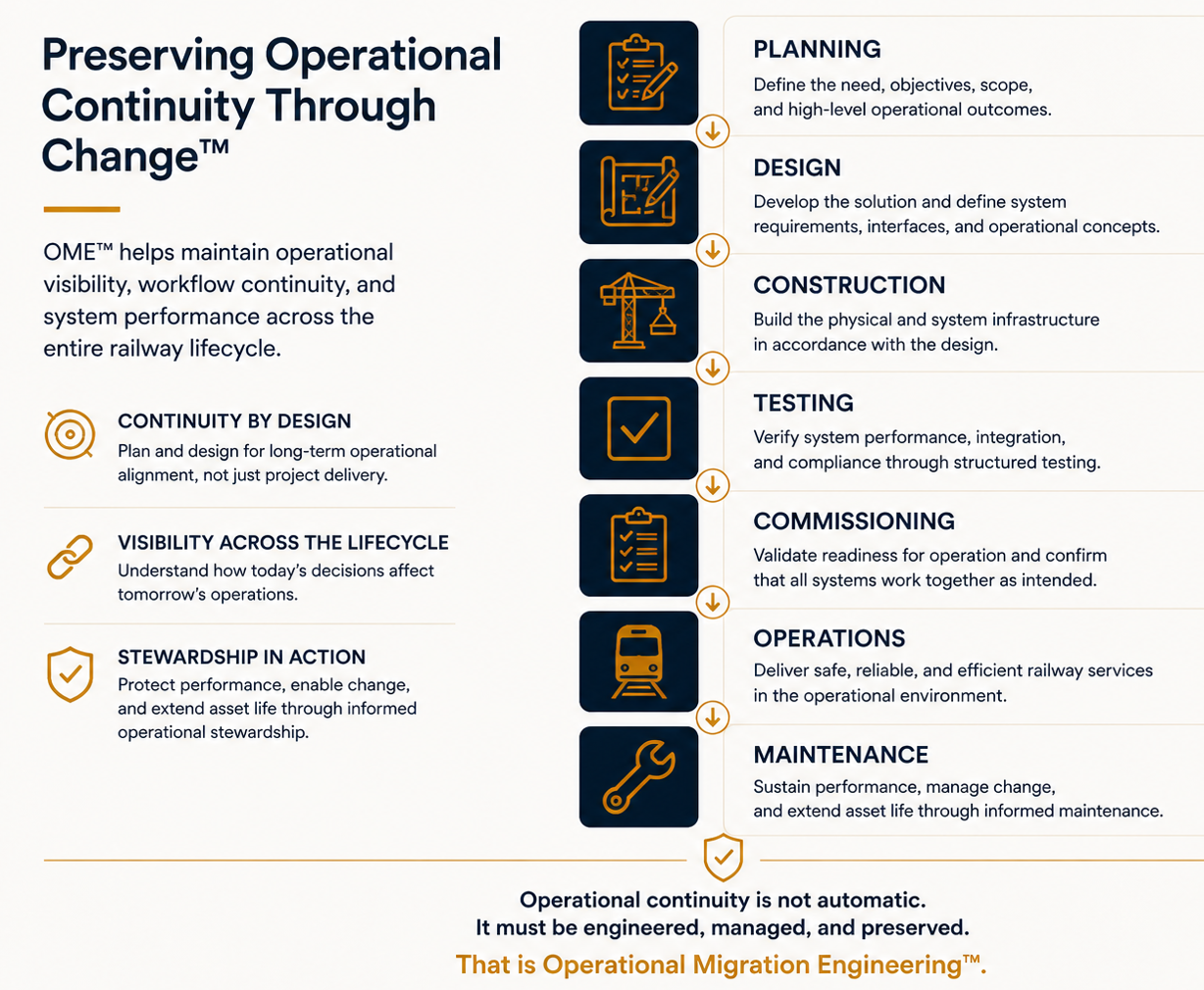
Operational Migration Engineering™ (OME™) is a practical railway methodology focused on understanding how project decisions affect future railway operations, operational readiness, system integration, and long-term operational performance.
OME™ helps bridge the gaps and dependencies between:
- Design
- Construction
- Testing
- Commissioning
- Operations
- Maintenance
- and future system expansion.
The focus is not only getting a railway open.
The focus is keeping the railway operationally stable, maintainable, and adaptable long after opening day.
The Delivery Gap
Most railway projects successfully deliver infrastructure, systems, and testing milestones.
However, operational success depends on more than project completion.
Between project delivery and stable railway operations exists a critical transition period where readiness, interfaces, stakeholder alignment, migration planning, and operational continuity must come together.
This is the Delivery Gap.
Projects may successfully achieve their contractual objectives while operational organizations continue working through challenges associated with transition, integration, readiness, and long-term operational sustainability.
OME™ focuses on helping organizations understand and manage the Delivery Gap before it becomes an operational problem.
Project Success vs Operational Success
Project success is often measured by construction completion, system installation, testing milestones, contractual deliverables, and schedule performance.
Operational success is measured differently.
Operational organizations evaluate success through reliable service delivery, operational readiness, maintainability, stakeholder preparedness, operational continuity, and long-term system performance.
While project success and operational success are related, they are not always the same thing.
OME™ encourages organizations to consider both perspectives throughout the railway lifecycle to improve the transition from project delivery to operational railway delivery.
Railway Ecosystem
Railways are often described as collections of systems.
- Signaling
- Communications
- Power
- Rolling Stock
- Operations
- Maintenance
However, successful railway operations depend on far more than individual systems performing correctly. Railways function as interconnected ecosystems where people, processes, organizations, and systems continuously interact. A technical decision can create operational consequences. An operational change can affect maintenance activities. A project decision can influence future expansion, readiness, or long-term system performance. Many operational challenges emerge not from a single failure, but from the interaction between multiple parts of the railway environment.
Understanding these relationships is essential to maintaining operational continuity, operational readiness, and long-term system stability.
OME™ encourages railway organizations to view the railway as a connected operational ecosystem rather than a collection of independent contracts, projects, organizations, or technical systems.
OME™ Doctrine
Operational Migration Engineering™ (OME™) provides a framework for understanding how project decisions, interfaces, dependencies, and organizational interactions influence operational outcomes.
OME™ encourages organizations to think beyond individual project deliverables and consider the railway as a connected operational environment.
The objective is not simply to deliver infrastructure, systems, or project milestones.
The objective is to support safe, reliable, maintainable, and sustainable railway operations throughout the life of the railway.
OME™ recognizes that many operational challenges do not originate within individual systems.
They emerge at the interfaces between systems, organizations, contracts, workflows, and operational responsibilities.
Integration is the goal. Interfaces are where the work happens.
By making interfaces visible and understanding their operational consequences, organizations can reduce fragmentation, improve coordination, and strengthen operational continuity throughout the railway lifecycle.
OME™ promotes lifecycle thinking, operational stewardship, and operational understanding as essential components of successful railway delivery.
OME Interface Engine™
The OME Interface Engine™ transforms project information into operational understanding.
Railway projects generate enormous amounts of information throughout planning, design, construction, testing, commissioning, and operational readiness activities.
The challenge is rarely a lack of information.
The challenge is understanding what that information means operationally.
The Interface Engine™ focuses on relationships, dependencies, interfaces, and operational consequences. Rather than viewing activities as isolated tasks, it helps reveal how decisions made within one area of the railway may affect other systems, organizations, stakeholders, or operational functions.
The Interface Engine™ helps identify:
• Interface dependencies
• Operational impacts
• Readiness risks
• Stakeholder effects
• Consequence pathways
• Hidden interconnections
By making these relationships visible, organizations can improve coordination, strengthen decision-making, and gain a clearer understanding of how project activities influence operational outcomes.
The result is greater visibility into the railway ecosystem and a deeper understanding of the factors that support successful operational delivery.
OME™ One App™
The OME™ One App™ delivers operational understanding when and where it is needed.
Built upon the principles of OME™ and informed by the OME Interface Engine™, the platform provides a consolidated operational perspective across the railway environment.
OME™ One App™ helps connect project activities, operational readiness, interface management, stakeholder coordination, and operational consequences within a single operational context.
Rather than simply presenting information, the objective is to improve understanding.
Users gain visibility into how project decisions, changes, risks, interfaces, and readiness activities may influence operational outcomes across the railway ecosystem.
By transforming operational understanding into actionable insight, OME™ One App™ supports informed decision-making throughout planning, delivery, transition, and operational phases of the railway lifecycle.
The goal is simple:
Provide the right operational understanding to the right people at the right time.
Why OME™ Matters
Many railway projects reach major milestones successfully but still struggle operationally afterward.
- Teams become separated.
- Responsibilities become unclear.
- Systems stop working together consistently.
Small gaps between design, construction, testing, commissioning, operations, and maintenance can slowly create larger operational problems over time.
In many projects, those problems are not discovered until late in testing — or after the railway enters service.
OME™ focuses on keeping people, systems, and operational workflows connected throughout the life of the project.
The goal is to reduce fragmentation early before it becomes part of the railway’s daily operation.
Operational Railway Delivery
Railway projects are often delivered in separate stages and contract packages.
- Civil works.
- Power systems.
- Communications.
- Signaling.
- SCADA.
- Operations.
- Maintenance.
Each group may complete its own work successfully while still creating operational problems for the railway overall.
Changes made by one team can affect testing, operations, maintenance, or future system expansion later in the project.
Without clear coordination, systems and workflows can slowly drift apart.
OME™ encourages early operational alignment between teams, systems, infrastructure, and future railway operations so the railway functions as one connected operational environment — not a collection of separate project packages.
Interface Coordination
Railway systems depend on many teams working together across different stages of the project.
A change made by one group can affect several others without anyone realizing it immediately.
A construction change can affect systems installation.
A network change can affect testing.
A testing shortcut can create future maintenance problems.
When communication between teams breaks down, operational problems usually appear later — often during commissioning or after opening day.
OME™ focuses on keeping interfaces visible between teams, systems, infrastructure, and operations throughout the life of the railway.
The goal is to reduce surprises, improve coordination, and help the railway operate as one connected system.
OME Raceway™
Railway systems continue evolving long after opening day.
New communications systems are added.
Networks expand.
Backup control centers may be introduced years later.
Operational technology continues changing throughout the life of the railway.
Many railways struggle because the original infrastructure was only designed for the initial installation.
OME Raceway™ encourages standardized operational pathways designed to support future expansion, redundancy, and long-term railway growth.
The raceway helps future systems connect into the railway more cleanly without repeatedly rebuilding infrastructure or disrupting operations.
OME™ treats pathway infrastructure as part of the railway’s long-term operational environment — not simply a construction activity.
Operational Stability
Opening day does not always mean a railway is fully stable operationally.
A system can appear technically complete while still struggling with:
- Coordination,
- Maintenance,
- Communications,
- Operational workflows,
- or long-term system reliability.
Many operational problems begin long before passengers enter service.
OME™ encourages operational alignment early in the project so testing, commissioning, operations, and maintenance teams remain connected throughout the life of the railway.
The goal is not simply to open the railway.
The goal is to keep the railway stable, maintainable, and operationally sustainable afterward.
Brownfield Railways
Expanding or modifying an active railway is very different from building a new one.
Existing operations must continue running while new systems, infrastructure, and operational changes are introduced.
That can create pressure between:
- Construction
- Testing
- Operations
- Maintenance
- and passenger service.
Small changes can affect live railway operations in ways that are not always immediately visible.
OME™ encourages early coordination between project teams and railway operations so expansion work remains connected to the long-term operational environment.
The goal is to help new and existing systems function together safely and consistently while the railway continues evolving over time.
Operational Expansion
Railway systems rarely remain unchanged after opening day.
New stations may be added.
Communications systems expand.
Backup control centers may be introduced.
Operational technology continues evolving over time.
Many future upgrades become difficult because the original railway was not designed for long-term operational growth.
OME™ encourages early planning for future expansion through coordinated infrastructure, operational documentation, interface visibility, and standardized operational pathways.
The goal is to help railways grow and adapt without creating unnecessary operational disruption later.
Operational Stewardship
Railway systems require long-term operational care long after construction is complete.
- Project teams eventually leave.
- Contractors change.
- Technology evolves.
- New systems are added over time.
Without clear operational ownership, railways can slowly become fragmented as systems, documentation, infrastructure, and operational workflows drift apart.
OME™ encourages long-term operational stewardship throughout the life of the railway.
The focus is not only delivering infrastructure.
The focus is helping the railway remain stable, maintainable, and operationally connected as it continues evolving over time.
The Future Railway
Modern railways are no longer static systems.
They continue evolving through:
- Expansion
- Technology upgrades
- Operational changes
- Communications growth
- and long-term infrastructure development.
OME™ views the railway as a connected operational environment that must remain coordinated throughout its entire lifecycle.
The goal is to help railway systems remain:
- Operationally stable
- Maintainable
- Adaptable
- and prepared for future growth.
Building the railway is only the beginning.
Keeping it operationally connected over time is the real challenge.
Every railway faces different operational, integration, readiness, and transition challenges. Let’s discuss yours.